April 6, 2026 marks the 100th anniversary of the inauguration of the Tablada Cut and the Alfonso XIII Bridge, infrastructures that transformed the Port of Seville.
The programme “Open Bridge” offers free guided micro-visits to the Iron Bridge on weekends throughout March, April, May and June.
On the occasion of the centenary of the Alfonso XIII Bridge and the Tablada Cut (1926–2026), the Seville Port Authority and the cultural management company Engranajes Culturales present the “Open Bridge” programme—an initiative that will allow citizens to access what is popularly known as the “Iron Bridge” through free guided micro-visits.
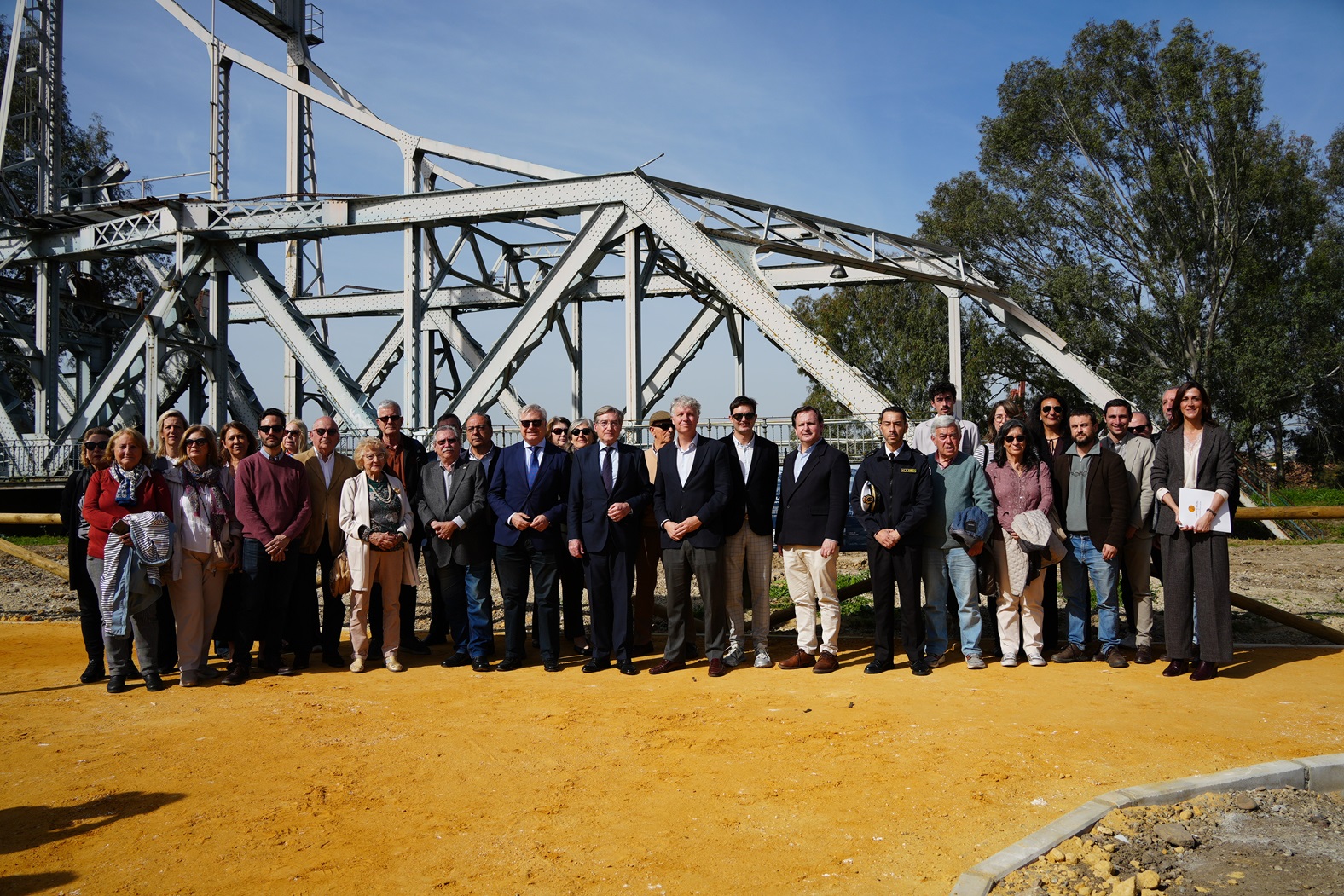
Through a route around the structure and supported by interpretive panels, visitors will be able to explore the Alfonso XIII Bridge, learn about its history, observe its structure, and appreciate this remarkable example of movable engineering, which forms part of Seville’s port heritage.
During the presentation event, the president of the Seville Port Authority, Rafael Carmona, stated: “We want citizens to get to know the bridge, its history and symbolism; therefore, we have adapted the surrounding area to make it accessible, coinciding with its centenary.” Carmona also noted that the Port Authority “is currently working on drafting a project to enhance its value, in collaboration with the Andalusian Institute of Historical Heritage. Our aim is to create a viewpoint space around the Iron Bridge, where citizens can gather to observe the water and the port activity in the Batán Dock.”
The event was attended by representatives of neighbourhood associations and local districts, organisations dedicated to the conservation of historical and industrial heritage, trade union representatives, members of the Naval Command, and relatives of the engineer Delgado Brackenbury, who directed the Port Works Board of Seville. It also featured the participation of the director of the Andalusian Institute of Historical Heritage, Juan José Primo Jurado; the commissioner for the centenary of the 1929 Exhibition, Julio Cuesta; and later joined by the president of the Seville Chamber of Commerce, Francisco Herrero.
100 years of the Tablada Cut
In April 2026, it will be 100 years since King Alfonso XIII, aboard the Argentine cruiser Buenos Aires and accompanied by other vessels of the Spanish Navy, inaugurated the Tablada Cut and the Alfonso XIII Bridge. These infrastructures, included in the reform project designed by engineer Moliní and completed by Delgado Brackenbury, shaped the new Port of Seville in the early 20th century.
In addition to the “Open Bridge” programme, the Seville Port Authority will commemorate the anniversary with an outdoor exhibition entitled “The Work that Transformed the Port of Seville”. Based on historical photographs and plans, the exhibition will be located on Avenida del Cid (next to the University of Seville) from March 26 to April 27.
An engineering landmark
The Alfonso XIII Bridge is a bascule bridge manufactured by La Maquinista Terrestre y Marítima of Barcelona, using a lifting system based on a patent from the Scherzer Lift Bridge Company of Chicago. This mechanism allowed two leaves to be raised simultaneously, opening the central span to enable vessels to pass through to the docks of Seville. The bridge was also designed with a 56° angular axis to allow the necessary railway movements.
The construction of the bridge over the dock was linked to the opening of the Tablada Cut, which avoided the meander of Los Gordales. This intervention marked the beginning of the modern port by extending quay lines, warehouses and sheds southwards, coinciding with the city’s development driven by the Ibero-American Exposition of 1929.
For decades, the bridge enabled maritime traffic to reach docks located further north in the city and remained in operation until the early 1990s. In the context of the Seville Expo, it was replaced by the current Las Delicias Bridge, as it became redundant.
In 1998, the bridge was dismantled, and the most prominent parts of its metal structure were preserved on an adjacent quay. In 2003, it was relocated downstream on the left bank, where it is now positioned to facilitate public viewing. The area where the bridge is located is part of the Port Urban District.
Today, the Seville Port Authority, in collaboration with the Andalusian Institute of Historical Heritage, is working on drafting the restoration project for the Alfonso XIII Bridge to enhance its value and ensure its conservation in its current location, within the future Port Urban District of Seville, as a central element of the “Bridge Theatre.”
Schedule and guided micro-visits
The “Open Bridge” micro-visits are free of charge and organised in 20-minute sessions.
📍 Meeting point: Former Alfonso XIII Bridge. Av. Guadalhorce, 7, 41012 Seville. Coordinates: 37°21’20.10″N 5°59’28.25″W
🚶 Pedestrian access available and nearby parking (subject to availability)
March and April
Morning visits
March: Sunday 22 and Saturday 28
April: Saturday 11, Sunday 12, Saturday 18 and Sunday 19
May
Morning visits
Saturdays 2, 9 and 16; Sundays 3, 10 and 17
Afternoon visits (gradually adjusted to sunset times, starting May 4)
Friday 8
Friday 22 and Saturday 23
Friday 29 and Saturday 30
June
Afternoon visits
Friday 5 and Saturday 6
Friday 12 and Saturday 13
Thursday 18 and Friday 19
Thursday 25 and Friday 26
Bookings and information
Advance booking is mandatory at:
👉 https://engranajesculturales.com/actividad/puente-abierto/