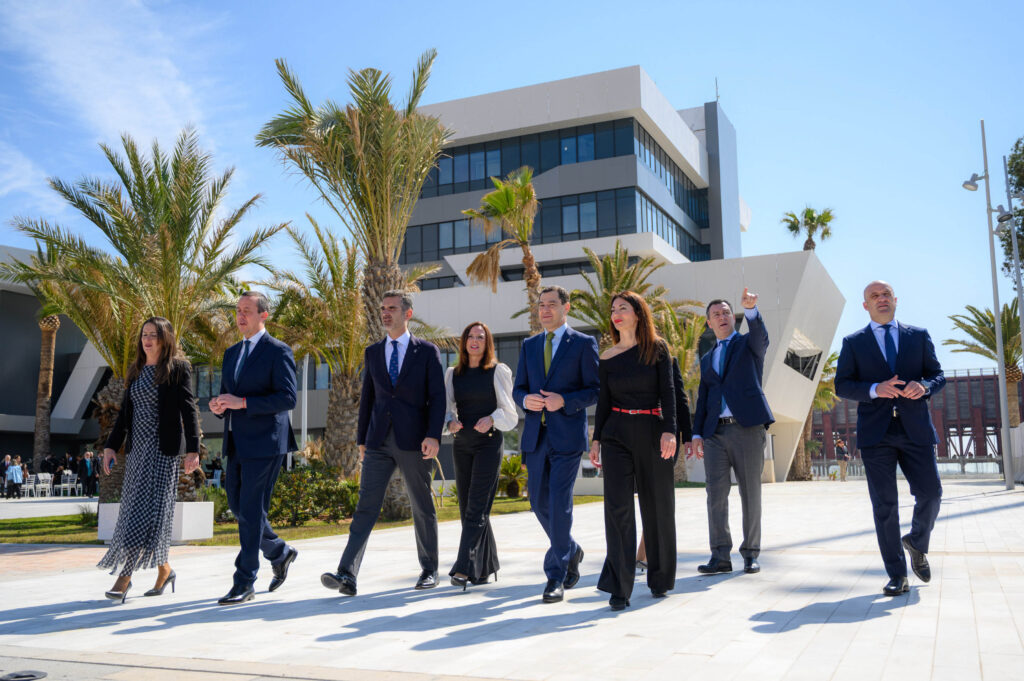
The President of the Regional Government of Andalusia, the Chairman of Puertos del Estado, the President of the Port Authority of Almería and the Mayor of Almería attend the open ceremony of the new open spaces
The two hectares integrated into the city include newly urbanised areas, the new façade of the APA administrative building, and the enhancement of rehabilitated port heritage
The port-city integration leaves behind 40 years of public demand and begins to become a reality with the completion of its first phase, inaugurated this Monday at an event attended by the President of the Regional Government of Andalusia, Juanma Moreno; the President of the Port Authority of Almería (APA), Rosario Soto; the Chairman of Puertos del Estado, Gustavo Santana; and the Mayor of the city, María del Mar Vázquez. “A historic and deeply moving event, in which we inaugurate, with the opening of two hectares of port land, the first phase of the urban integration of the port with the city, removing barriers and providing large, accessible spaces open to the sea,” said Soto.
The President of the Regional Government of Andalusia, Juanma Moreno, highlighted: “We are talking about a complex initiative that Almería had been demanding for 40 years. It creates the Almería brand and the Andalusia brand. But this is only the beginning. The next step will be the main phase of the project so that Almería can finally achieve this long-standing aspiration: to fully open up to the sea from its historic centre and remove a physical barrier standing between the city and its future.” In this regard, he noted that once this first phase has been completed, work will begin on the core part of the project, in which the Regional Government of Andalusia will invest €15 million, five of which are already included in the 2026 Budget.
The President of the Port Authority of Almería thanked APA staff for their work in making this first phase possible in three years, with an investment of nearly €10 million. During this period, the port authority has positioned itself among the five fastest-growing in the national port system, doubled its profits, attracted investment and generated employment, all while maintaining zero debt. Soto also stressed that the inauguration marks a new stage in the opening of the Port of Almería, which will continue with the urbanisation of a further four hectares at the Levante Wharf and Las Almadrabillas. “A comprehensive intervention that would not be possible without the guarantee and commitment of the Regional Government of Andalusia,” which has granted the APA a €15 million subsidy, as well as the collaboration of Puertos del Estado and the Almería City Council.
Gustavo Santana, Chairman of Puertos del Estado, underlined the organisation’s commitment to “promoting initiatives that foster the integration of ports with their cities across the entire Spanish port system.” “We are convinced that initiatives like the one inaugurated today in Almería represent a strategic investment that generates long-term value: they revitalise spaces, promote economic activity, improve citizens’ quality of life and reinforce the maritime identity of our cities.”
For her part, the Mayor of Almería, María del Mar Vázquez, stated that the inauguration of the first phase of port-city integration represents “a great day for the city,” as it marks the beginning of a historic transformation that definitively connects the port with the urban centre. She emphasised that it is a project that will mark “a before and after,” shaping a more open, accessible and future-ready Almería. She also highlighted the urban, social and economic impact of this first phase, which creates new public spaces, improves the connection with the sea and boosts tourism and economic activity. “We are witnessing the greatest urban transformation of the last 30 years,” she affirmed.
Opening, urban development and recovery of port heritage
The first phase of port-city integration, in which the APA has invested €9 million of its own funds, involves opening two hectares of public port land. The project includes the urbanisation of one hectare at the entrance to the Levante Wharf, combining locally sourced natural materials and innovative surfaces such as Dekton by Cosentino, Macael white marble, travertine and Almería granite. It also includes the construction of the new façade of the APA headquarters, featuring a cutting-edge design that improves the building’s energy efficiency. This project has received EU Feder funding and has been awarded the 2025 Macael Sustainability Award, as well as being selected by The Masters by Elle Decoration as one of the ten outstanding projects of 2025, highlighted in the Public Works category.
As with the restoration of the “Cable Inglés” ore loading facility in Las Almadrabillas, the APA has also enhanced port heritage in the newly opened spaces. In this regard, it has restored the Babcock & Wilcox crane from the 1960s, adapting it into a viewpoint offering panoramic views of the port and the city. It has also restored the German Deutz locomotive, manufactured in 1928 and acquired by the Port of Almería in 1929, returning it to its original condition nearly a century later. In addition, the “tinglado”, an early 20th-century structure used for commercial purposes and goods storage, has been refurbished to provide more than 2,600 square metres of shaded space in the urbanised areas. Furthermore, another hectare of port land has been opened up to the edge of Ribera I Wharf, which will also be available for social, cultural and sporting activities.
Four more hectares at Levante Wharf and Las Almadrabillas
This first phase of port-city integration, carried out by the APA and involving the removal of part of the fence separating the Port of Almería from the city—following similar works on the western side last year, where the historic Varadero building was restored and the entrance was completely redesigned with a new direct access—will be followed by the main phase of the project. This phase is scheduled for 2027 and 2028 and will cover four hectares at Levante Wharf and Las Almadrabillas, where plans include the development of hospitality establishments and the enhancement of the Harbour Master’s and Maritime Rescue buildings for port-city use.