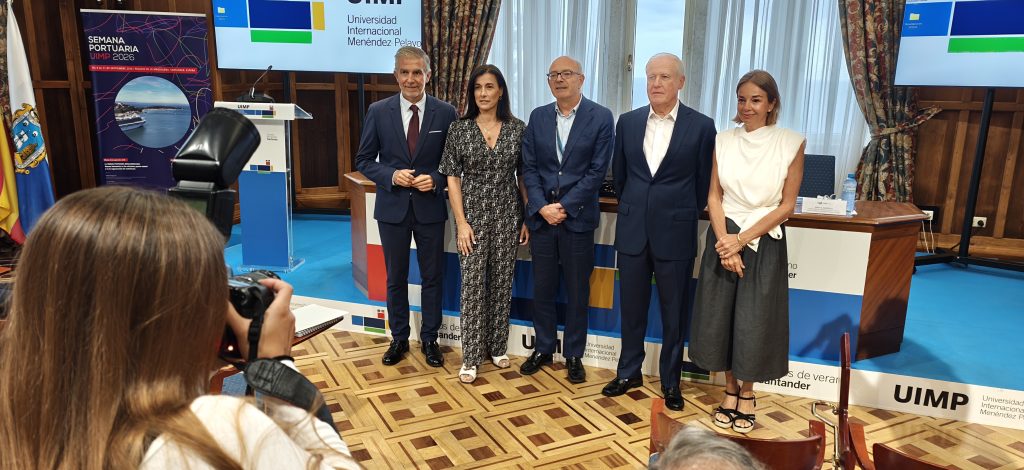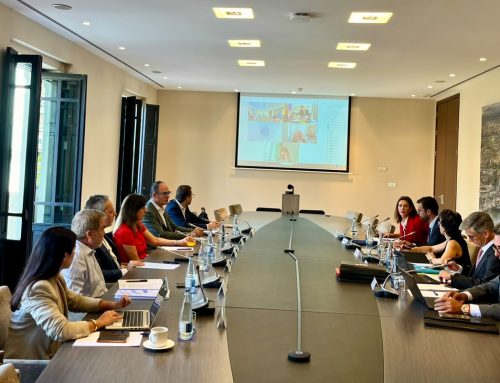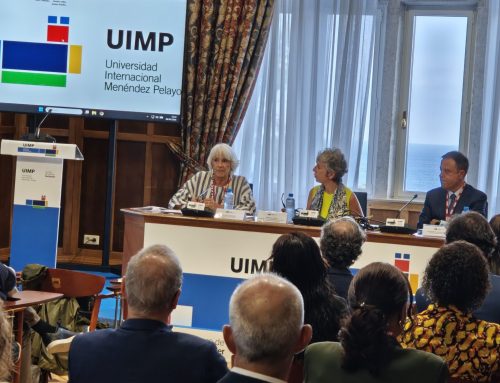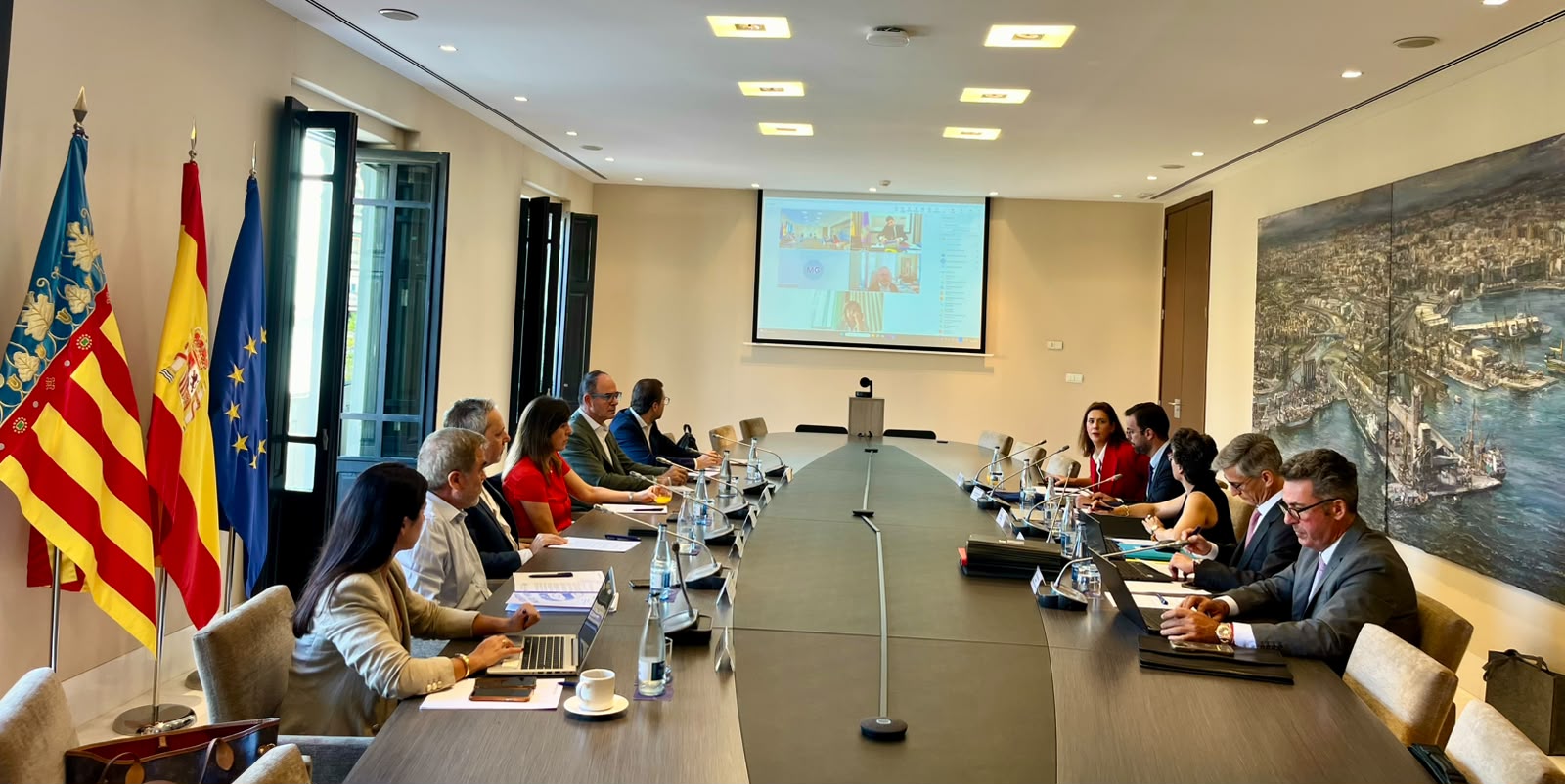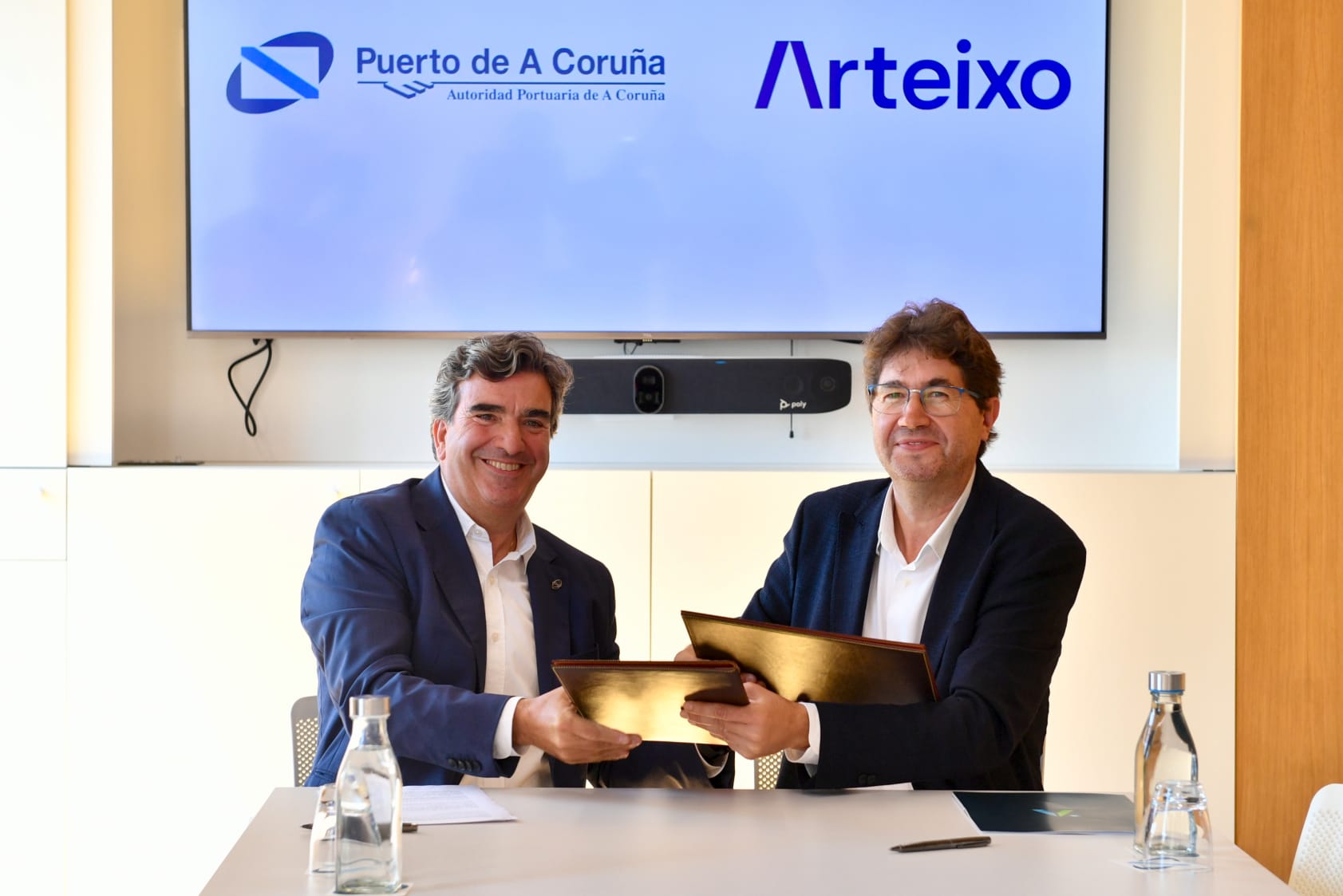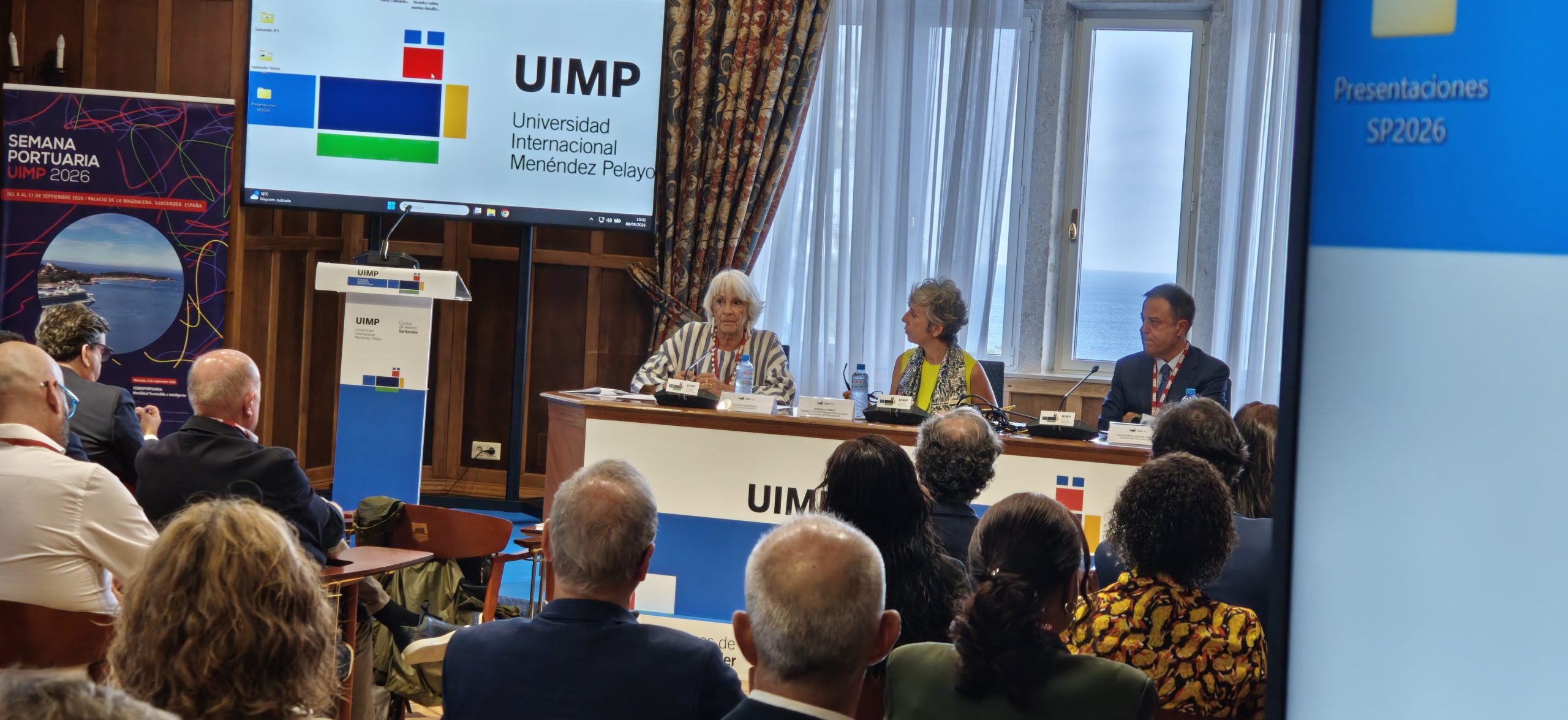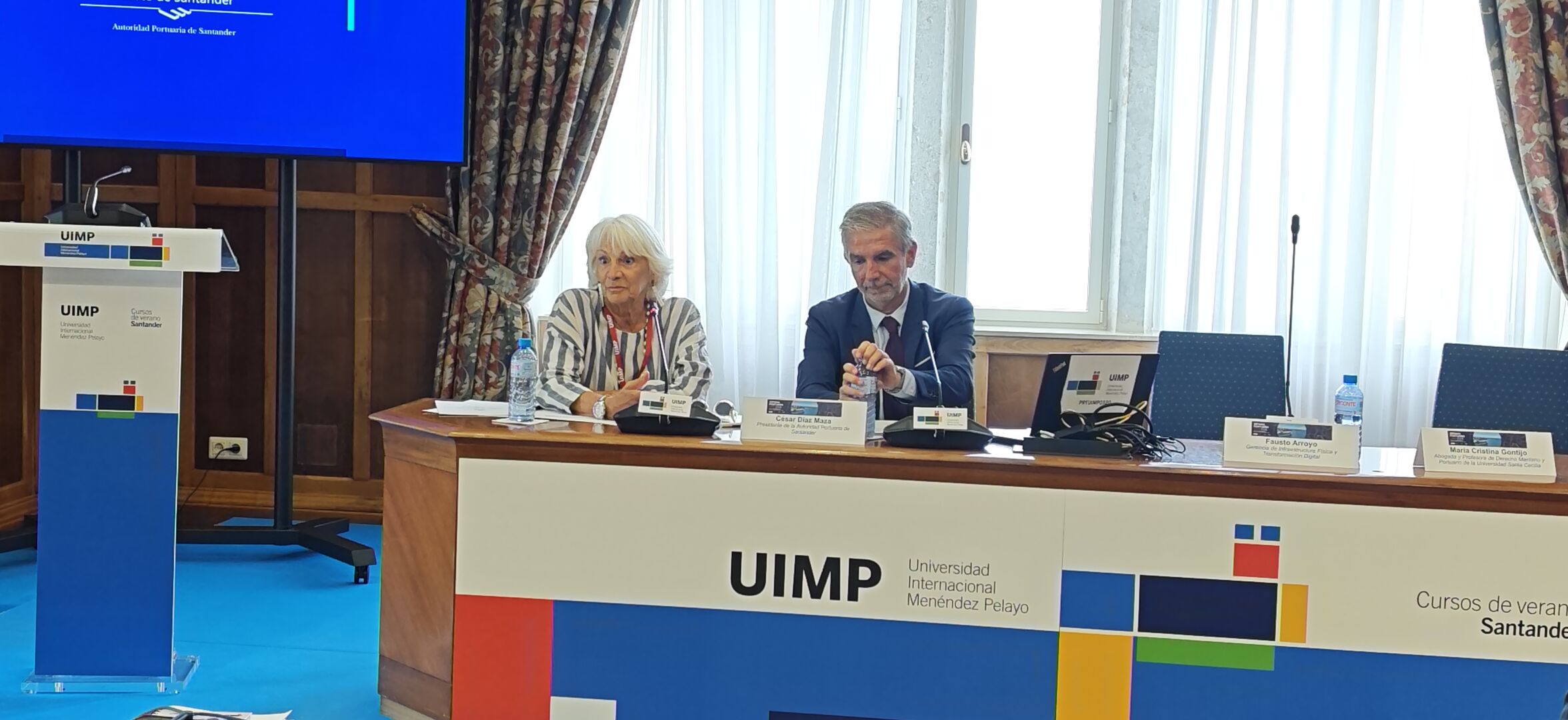
The opening session of UIMP Port Week 2026, directed by Teófila Martínez and César Díaz Maza, brought together experiences from Portugal, Spain and Latin America and highlighted a common theme: the future of ports is also decided beyond their quays, through governance, mobility, social licence, sustainability and the ability to build cities and territories
By Jesús de Sobrino | Head of Communications at RETE
Santander, 8 September 2026.- One idea ran through the opening day of Santander Port Week 2026 from beginning to end: the port no longer ends at its perimeter. It continues along the roads used by its cargo, on the railway lines connecting it to its hinterland, in the neighbourhoods affected by its traffic, in the energy it consumes, in the jobs it generates, in the spaces it gives back to the city and, above all, in the way it is perceived by the people who live around it.
That shift in scale —from the port precinct to the city and from the city to the wider territory— was the real thread running through “The Ibero-American Port City: New Horizons in Port-City Relations and Waterfront Regeneration”, the meeting that opened UIMP Port Week 2026 this Tuesday at the Palacio de la Magdalena.
The session was directed by Teófila Martínez Saiz, President of RETE and President of the Port Authority of the Bay of Cádiz, and César Díaz Maza, President of the Port Authority of Santander, with Francisco Javier Álvarez García, Head of the Department of General Administration and Legal Services at the Port Authority of Santander, acting as secretary.
The starting point was ambitious. Port cities are undergoing profound transformation as a result of the digital revolution, the transition towards more sustainable models and other major economic, technological and social changes. The meeting therefore set out to compare different Ibero-American realities and identify common elements for a new generation of port-city cooperation policies capable of simultaneously strengthening competitiveness, resilience and quality of life.
The programme was structured around two broad discussions. The first focused on the current challenges facing port-city relations in Portugal, Latin America and Spain. The second moved to specific cases, examining six experiences in the transformation and regeneration of port-city waterfronts: Buenos Aires, A Coruña, Lisbon-Leixões, Santos, Chancay and Santander.
Teófila Martínez: integration must go “beyond urban planning”
It was Teófila Martínez who set the conceptual framework for much of the morning’s debate. The President of RETE rejected a narrow understanding of port-city integration as simply the physical redevelopment of land that has ceased to serve a port function.
For many years, she recalled, the relationship between ports and cities was approached through isolated interventions: a quay that fell out of use, a site that changed function or an area that was opened to the public. None of those actions, in themselves, amount to a genuine integration strategy.
“Port-city integration goes beyond urban planning, the distribution of land and its use; it has a much broader dimension, encompassing economic, social and cultural aspects,” she said.
Her remarks introduced a theme that would reappear throughout the morning: there is little point in physically transforming a waterfront if the result does not generate activity, coexistence, opportunity and social value. The challenge is not simply to make land accessible, but to ensure that the space once again becomes part of the economic, social and cultural life of the city.
Martínez placed one of the principal values of RETE as an international network of knowledge and experience precisely here. She recalled that rete means “network” in Italian and defended the exchange of both good and bad practices as a means of avoiding the need for every port city to start from scratch.
The experience accumulated over decades in very different ports makes it possible to identify what has worked, which mistakes can be avoided and which solutions can be adapted —rather than simply copied— to other territories.
The President of RETE also introduced another important conceptual shift: it is no longer enough to think about the city; we must think about the territory.
Major port infrastructure affects logistics corridors, rail and road systems, metropolitan areas, mobility, land use and economies located tens or even hundreds of kilometres from the quays.
“We have moved from looking at what concerns the port city and the port itself to also thinking, from the port’s perspective, about the wider territory,” Martínez said.
Alongside this strategic perspective, another major constraint emerged: time. Large port-city projects require years to define, agree, process and implement. Martínez therefore called for more agile, faster and more efficient procedures and regulatory frameworks. A solution delivered ten or fifteen years late may already be responding to a reality that has changed.
From physical boundaries to interdependence
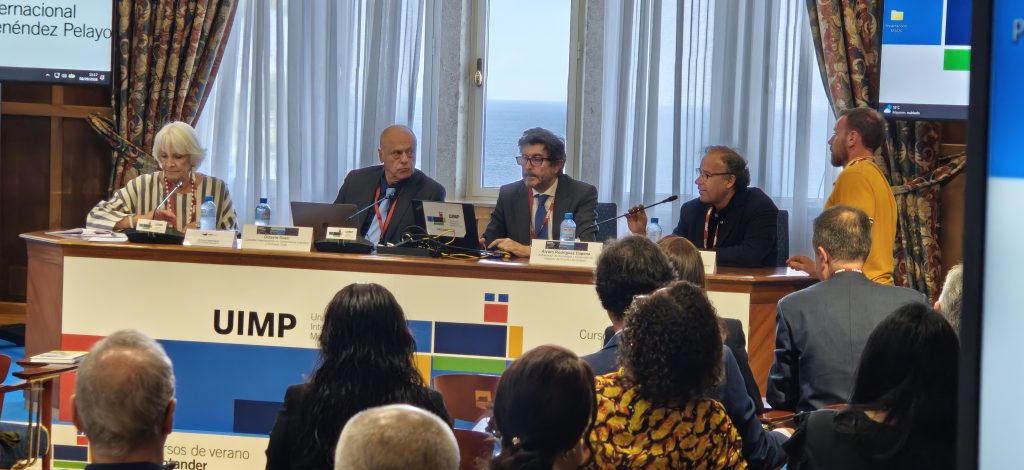
With these premises established, the first block began: “Port-City Relations in Ibero-America: Current Challenges and Inspiring Experiences”, structured around three successive perspectives —Portugal, Latin America and Spain— presented by João Figueira de Sousa, Octavio Doerr and Álvaro Rodríguez Dapena.
The three contributions showed that institutional, geographic and economic differences are enormous, yet the problems increasingly look alike.
Digitalisation, decarbonisation, energy transition, mobility, landside access, climate adaptation, urban quality, employment, housing, citizen participation and governance are no longer separate agendas. They now converge on the same territory.
João Figueira de Sousa: integration does not mean mixing everything together
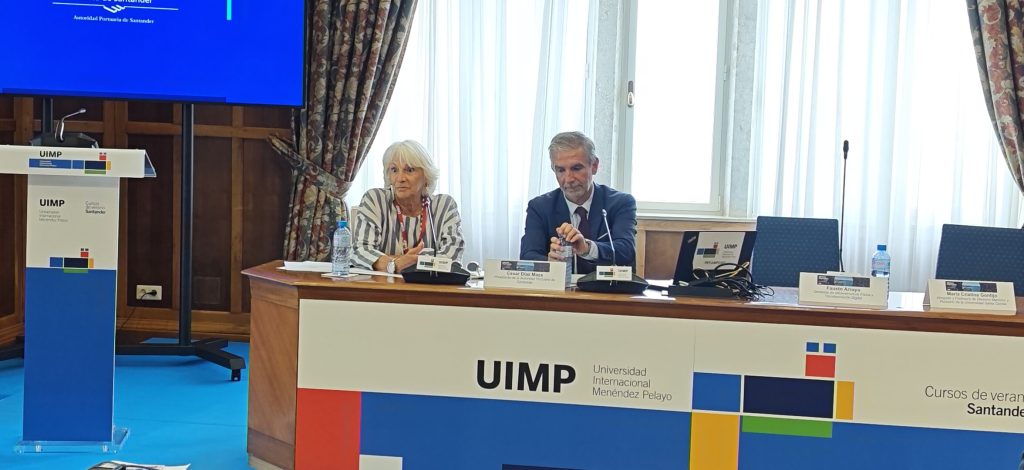
João Figueira de Sousa, Professor at the Department of Geography and Regional Planning at NOVA University Lisbon, opened the discussion from a Portuguese perspective, emphasising the speed at which change is occurring.
Issues that only a few years ago might have belonged to discussions about “the port of the future” are already current realities: alternative fuels, energy transition, automation, digitalisation, logistics resilience and adaptation to climate change.
Ports and cities can no longer address these transformations in isolation because they operate within an increasingly interdependent system.
Figueira de Sousa introduced another useful principle: integration does not mean mixing everything together.
Certain port activities, for operational, environmental or safety reasons, need to remain separated from specific urban uses. Others can coexist, while some —public space, knowledge, innovation, culture, training and certain forms of mobility— can even be shared.
The real challenge is to determine what must remain separate, what can coexist and what can be built jointly.
The Portuguese experience also demonstrates that there is no single model even within the same country. A large port embedded in a complex metropolitan area cannot be compared with smaller regional or island ports. Responses must emerge from the specific geography, port function, institutional framework and social reality of each territory.
For this reason, the Portuguese academic identified governance as one of the central issues in the new port-city agenda: ports are not islands, and cities cannot be seen merely as recipients of either the benefits or the impacts of port activity.
Octavio Doerr: without social licence there is no competitiveness either
Octavio Doerr, from Port Research & Consulting, shifted the focus to Latin America, a region that has undergone an extraordinary modernisation of its port infrastructure over recent decades.
New terminals, public and private investment, growth in trade, increased logistics capacity and technological advances have radically changed the sector. But that same process has also generated a new range of tensions between ports and their surroundings.
Each Latin American case has its own particularities, but Doerr identified a common agenda: territorial pressure caused by port expansion, road congestion, the need to improve access, environmental and energy transition, relations with communities and institutional fragmentation.
One of his most striking observations was that many of today’s port bottlenecks are actually located outside the port itself.
A terminal may achieve exceptional levels of productivity and automation, yet lose much of that efficiency if trucks encounter congested road networks, rail connections are inadequate or freight traffic cuts through urban areas and creates conflict.
Competitiveness can therefore no longer be measured only in terms of draught, available hectares, quay capacity or crane moves per hour. It depends on how the entire territorial system functions.
It was at this point that Doerr introduced one of the concepts that most clearly summed up the day: social licence.
“There is no competitive port without social licence,” was the essence of his argument.
This is not an administrative permit. It is the legitimacy that infrastructure earns from the community with which it coexists. And that legitimacy cannot be improvised at the end of a project through a communications campaign: it must be built from the outset through transparency, participation, dialogue and the ability to share the benefits of development.
His analysis also led to another particularly relevant conclusion: many problems commonly interpreted as infrastructure conflicts are in fact governance problems. Authorities, operators, municipalities and communities work with different timelines, incentives, information and priorities. The answer does not always require more infrastructure. Sometimes it requires better mechanisms for making decisions together.
Álvaro Rodríguez Dapena: who do ports belong to?
The third perspective came from Álvaro Rodríguez Dapena, Deputy Director for Strategy and Business Development at Puertos del Estado, who explained the specific features of the Spanish model.
The system combines strategic direction at national level with broad management autonomy for individual port authorities and significant involvement by regional and local administrations in processes affecting the territory.
This distribution of responsibilities turns port-city relations into an exercise in co-governance. The State, autonomous communities, municipalities and port authorities all need to cooperate when decisions simultaneously affect the economy, public land, urban space, mobility, sustainability and spatial planning.
Rodríguez Dapena placed the recent evolution of the Spanish port system within a framework in which three dimensions must progress together: economic, environmental and social.
The traditional objective of improving connectivity and logistics positioning has been joined by energy and environmental transition and, increasingly, by the commitment of ports to the societies of which they form part.
He then posed an apparently simple question with profound implications: who do ports belong to?
Beyond who manages a terminal, holds a concession or administers a given area, ports form part of a system and a public-interest asset. Seeing ports from this perspective inevitably changes how waterfront regeneration, the opening of spaces and relations with citizens are understood.
Spain has accumulated very different experiences over recent decades. The conclusion is that port-city relations should not depend solely on the personal rapport that may exist at a particular moment between a mayor and a port authority president. They require permanent mechanisms for cooperation, institutional trust and commitments capable of surviving political change.
The discussion that closed the first block extended this reflection into one of the great paradoxes facing all port cities: ports are part of global networks, while many of the consequences of their decisions are concentrated locally. The answer is not to choose one scale over another, but to learn how to govern both simultaneously.
Waterfront Revisited: six experiences and no universal recipe
The second half of the morning deliberately moved away from general principles and into specific cases.
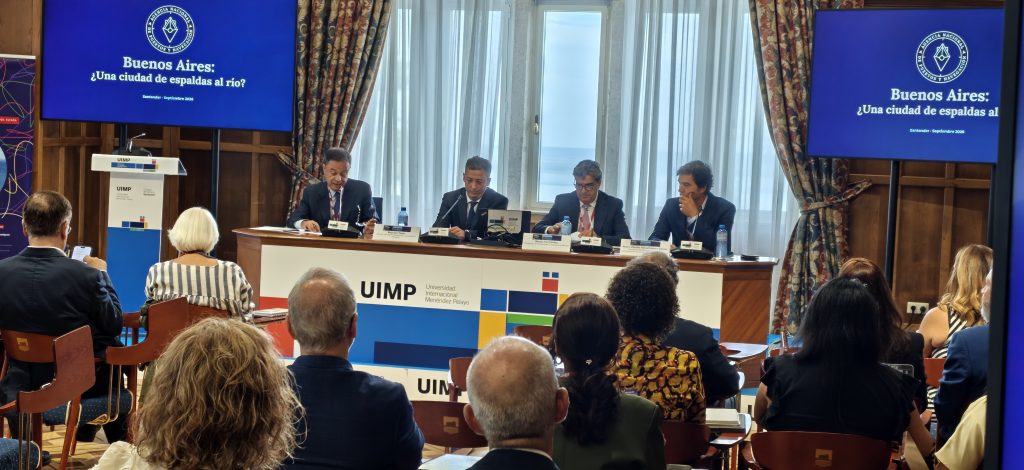
Under the heading “Waterfront Revisited: The New Generation of Maritime-Port Fronts in Ibero-America”, the experiences of Buenos Aires, A Coruña, Lisbon-Leixões, Santos, Chancay and Santander showed that very different realities sit behind a single term —waterfront.
That diversity was perhaps one of the first conclusions of this second block: there is no exportable waterfront model.
Buenos Aires is not A Coruña; Lisbon is not Santos; Chancay is not Santander. The relevant question is therefore not which project should be copied, but what problem each city is trying to solve and what kind of relationship it wants to build between port, economy, territory and citizens.
Buenos Aires: after Puerto Madero, explaining the port once again
Marcelo Teper, Director of the National Port Training Centre at Argentina’s National Ports and Navigation Agency, turned to history to explain Buenos Aires’ complex relationship with its port.
The evolution of Puerto Madero illustrates many of the dilemmas that have accompanied waterfronts for more than a century. Originally designed to meet port needs, the area was soon overtaken by the changing size of ships and the evolution of maritime trade. Operations eventually moved elsewhere, while the former port zone later became one of the most valuable urban districts in Buenos Aires.
The port moved away functionally while the city reclaimed its frontage.
But reclaiming land does not necessarily mean restoring the relationship with the water. Road infrastructure, the airport, operational facilities, docks and protected areas continue to form physical barriers between large parts of the city and the Río de la Plata.
Teper showed how that relationship has entered a new phase through direct cooperation between port and city. One example is the Paseo del Bajo, which reorganised heavy traffic, improved port access and reduced road pressure in certain urban areas.
But integration, he stressed, does not end with infrastructure.
The Buenos Aires experience also encompasses training, outreach, heritage and culture. Recovering historic elements, creating educational spaces, organising visits and explaining port professions all help to open the port to a society that often has little idea what takes place behind its boundaries.
His contribution therefore offered a particularly interesting interpretation of the concept of openness: a port also opens up when it explains what it does.
A Coruña: consensus as the first major achievement of Coruña Marítima
The intervention of Martín Fernández Prado, President of the Port Authority of A Coruña, introduced a different perspective. Before even discussing urban planning, architecture or future uses, the A Coruña case demonstrates the importance of something probably more difficult to build than any of the infrastructure that will come later: consensus.
The transformation of A Coruña’s port waterfront is not being developed on a blank canvas. State, regional and local authorities, the port authority and the railway system all have legitimate competences, needs and interests in the area. This is compounded by the economic activity that will remain in the inner port, citizens’ expectations and differing political sensitivities.
Bringing all of these parties around the same table has been, as Fernández Prado stressed, one of the greatest challenges of the process. Achieving this regardless of political colours and of the different institutional logics involved is itself one of the major accomplishments of the A Coruña experience.
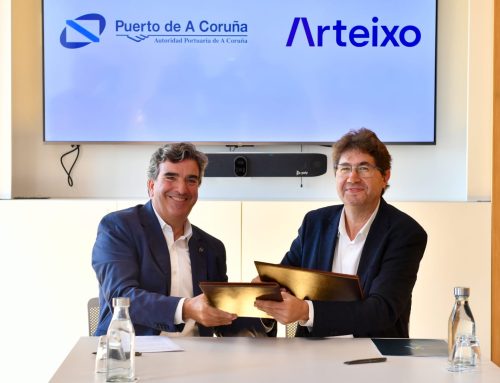
That consensus is embodied in Coruña Marítima, a project formally launched through a protocol signed in May 2024 by A Coruña City Council, the Xunta de Galicia, the Ministry of Transport and Sustainable Mobility, ADIF, Puertos del Estado and the Port Authority of A Coruña to jointly address the transformation and reorganisation of a major part of the inner port.
This is not merely declarative cooperation. The governance of the project rests on the Coruña Marítima Commission, which brings together these institutions and agencies along with all political groups represented on the city council. Its strategic foundations explicitly stress the need to achieve broad agreements and preserve several essential principles: maintaining public ownership of the land, safeguarding port activities that are not transferred to Punta Langosteira, opening to citizens those areas that lose their port function and reconciling the Port Authority’s financial balance with a broad social return for the city.
The project is also currently immersed in defining its Master Plan. In April 2026, five finalist teams were selected from fourteen valid applications in a multidisciplinary process involving urban planning, architecture, mobility, landscape, engineering and port expertise.
But Fernández Prado focused less on presenting the final image of a transformation still under development than on explaining how it has been possible to reach the point where that image can begin to be designed jointly.
Coruña Marítima also includes a process of participation and social engagement so that consensus is not confined to institutions alone. This may be the principal lesson of the case.
Before physically transforming a waterfront, it is necessary to create a political, administrative and social framework capable of sustaining that transformation over many years, even as governments and individuals change.
In A Coruña, the first major achievement of Coruña Marítima has been getting everyone to agree.
Lisbon and the Tagus: when the waterfront becomes a territory
The contribution by architect Nuno Viterbo da Cunha Abrunhosa e Sousa shifted the discussion to a completely different scale.
Although scheduled under the Portuguese experience of Lisbon-Leixões, his presentation focused particularly on the enormous territorial complexity represented by Lisbon and the Tagus estuary.
Here, it is difficult even to speak of a waterfront in the singular.
The jurisdiction of the Port of Lisbon encompasses the riverfronts of eleven municipalities —Oeiras, Lisbon, Loures, Vila Franca de Xira, Benavente, Alcochete, Montijo, Moita, Barreiro, Seixal and Almada— and extends along 273 kilometres of shoreline, with a river-maritime area covering 31,600 hectares.
In other words, this is far more complex than the boundary between a port and a city. It is an entire territorial system organised around one of Europe’s major estuaries.
This scale multiplies the ownership structures, competences and functions that coexist along the river: port and municipal domains, infrastructure, private concessions and operations, port facilities, cultural areas, civic amenities, sites linked to defence, recreational spaces and zones of extraordinary environmental value.
The Port of Lisbon itself recognises that this diversity of municipal realities makes port-city relations particularly complex and has set as an objective the creation of a more continuous territory in which the fractures and discontinuities between urban and port areas are gradually reduced.
This administrative complexity is compounded by another essential variable: the environmental value of the estuary. More than 50% of the Port of Lisbon’s jurisdiction lies within the Natura 2000 network, while a significant share of port activity simultaneously takes place in the heart of the Portuguese capital.
This helps explain one of the central lessons of Viterbo’s presentation: integration does not necessarily mean transferring port land to the city.
In a setting of this scale, integration often means coordinating, sharing and stitching together.
The Port of Lisbon Authority itself participates in planning instruments covering the eleven riverfront municipalities and develops projects and works with them through cooperation agreements intended to improve the riverfront and facilitate public use. In some areas, cooperation also requires the involvement of other public stakeholders, as occurred with the reorganisation of Doca da Marinha, involving the municipality, the port and the defence authorities.
Lisbon therefore offers another lesson in the Santander discussion. Waterfronts are not always transformed through a single spectacular operation.
Sometimes integration is a patient process of territorial stitching, carried out section by section, municipality by municipality, concession by concession and agreement by agreement.
On the Tagus, the term port-city relationship almost becomes too narrow: the port is not in dialogue with a single city, but with an extraordinary mosaic of cities, administrations, heritage assets, economic activities, ecosystems and citizens sharing the same riverfront.
Santos: a major logistics powerhouse forced to manage everyday coexistence
With Maria Cristina Gontijo, Professor of Professor of Maritime Law at Unisanta, and member of the teaching team at the Santos Port Centre of Excellence, the discussion shifted scale once again.
Santos is a critical piece of infrastructure for Brazil and for a significant share of South American trade. At the same time, it is a major port embedded in an extraordinarily complex urban and metropolitan fabric.
That dual condition makes the port-city relationship something far more everyday than simply transforming a waterfront.
It involves trucks, railways, congestion, housing, employment, safety, pollution, energy transition, vocational training and land availability.
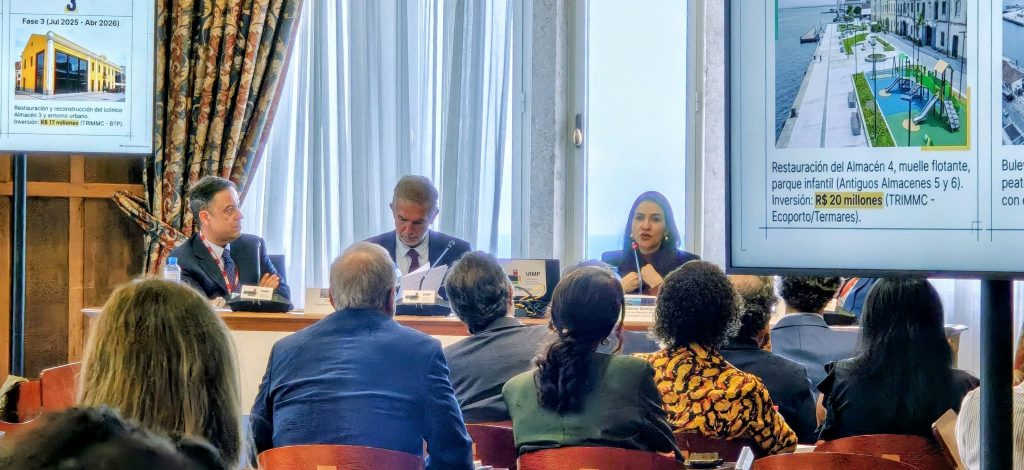
Gontijo reviewed the distinctive features of the Brazilian port system, where terminals and ports operate under different management regimes, and explained how the growth of Santos requires solutions extending well beyond the physical boundaries of its terminals.
Expanding capacity requires better landside connections. Technological modernisation requires skills. Sustainability requires climate considerations. And the sheer scale of freight flows demands mechanisms capable of coordinating vehicles and cargo more efficiently in order to reduce their impact on the city.
Here again, technology can become a tool for integration. Digitalising logistics flows and reducing waiting times are not merely operational improvements: they directly affect mobility and urban quality.
But the Brazilian speaker also stressed the social and educational dimension.
A port of Santos’ scale needs its surrounding community to understand what it represents and to find opportunities within it. Vocational education, cooperation with universities, educational activities, heritage and culture are also part of building that relationship.
Ultimately, Santos cannot simply be a vast logistics facility beside a city; it needs to be recognised as part of the city itself.
Chancay: when infrastructure advances faster than the territory
If Buenos Aires invited the audience to look back at history and Santos illustrated the challenge of managing highly intensive coexistence, Chancay raised an almost opposite question: what happens when a new-generation port advances far more quickly than the territory that must absorb it?
Fausto Arroyo, from the Physical Infrastructure and Digital Transformation Department of CAF —Development Bank of Latin America and the Caribbean— analysed the territorial consequences of the new Peruvian port.
The case is particularly revealing.
A modern, highly automated, high-capacity terminal with ambitions to become a major connection hub between South America and Asia is being developed alongside a much smaller town, within a territory that must adapt rapidly to a transformation of enormous scale.
The infrastructure creates extraordinary opportunities: investment, employment, industrial and logistics activity, new corridors, international connectivity and the potential to create a major economic pole.
But none of those opportunities automatically becomes development.
That was one of the key messages in Arroyo’s presentation: building the port is not enough.
The territory needs roads, rail connections, urban planning, housing, public services, healthcare, training, institutional capacity and social cohesion to absorb the change.
If these processes do not advance in a relatively coordinated way, a huge gap may emerge between the sophistication of the terminal and the reality of the territory around it.
Chancay therefore made it possible to distinguish very clearly between investment and territorial development. Infrastructure can act as a powerful catalyst, but the final outcome will depend on how its impacts are governed and on the ability of investors, authorities and local communities to construct a shared agenda.