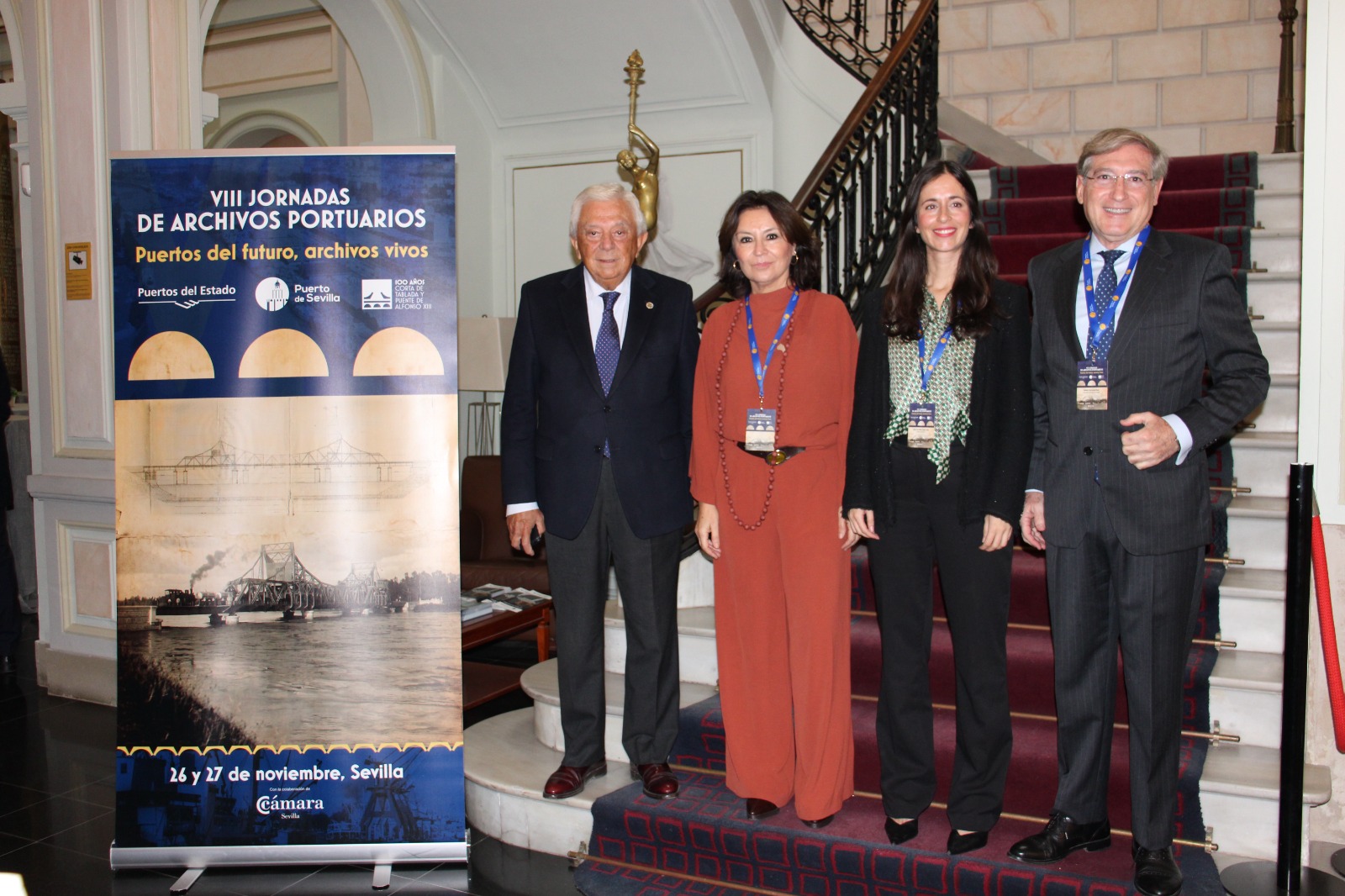
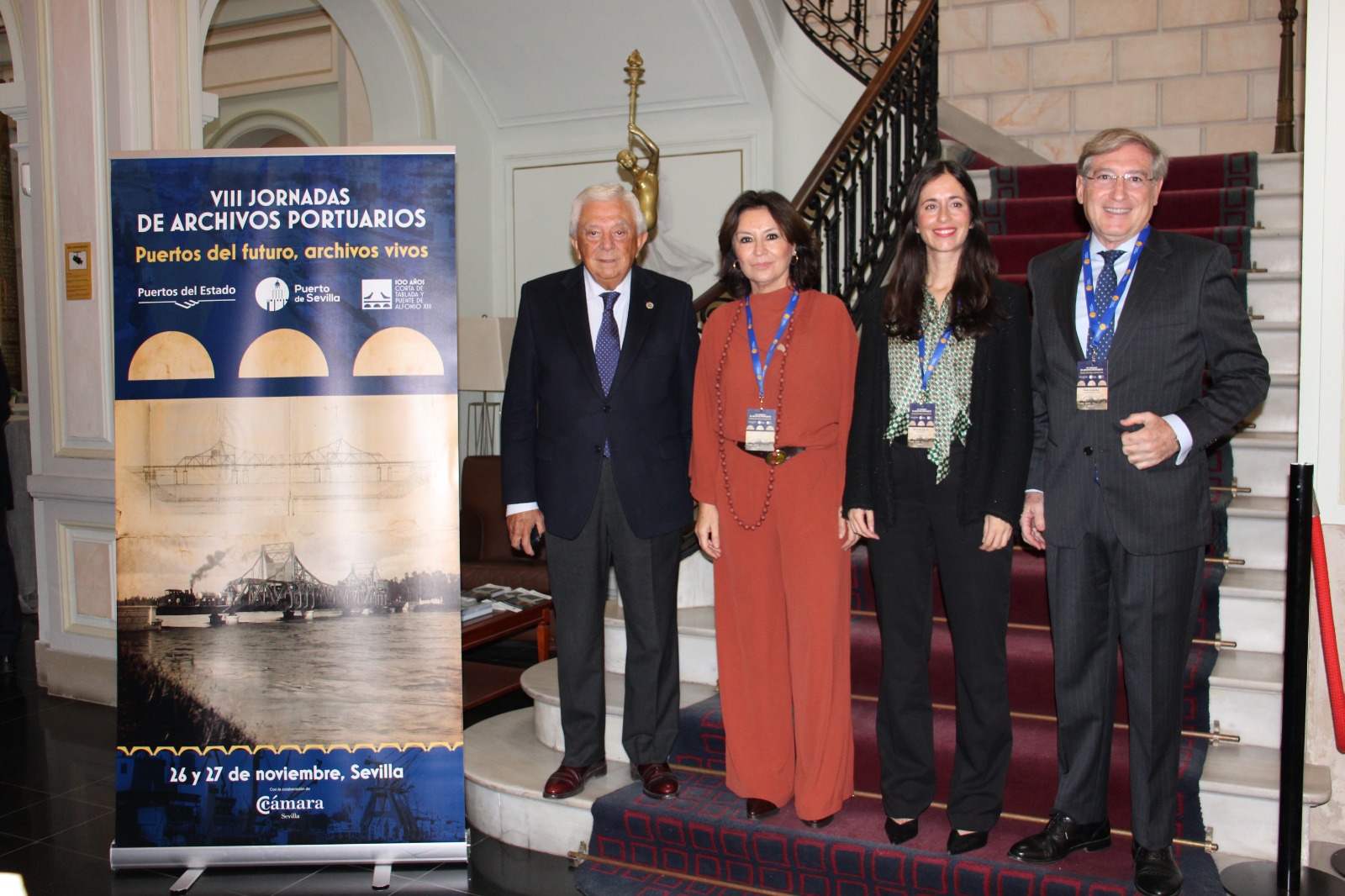
Under the title ‘Ports of the Future, Living Archives’, the event is being held as part of the centenary celebrations of the Tablada Channel and Wharf and the Alfonso XIII Bridge.
The 8th Port Archives Conference, organised by the Port Authority of Seville and Puertos del Estado under the title ‘Ports of the Future, Living Archives’, began today. This national gathering, taking place in the auditorium of the Seville Chamber of Commerce, brings together more than 70 archivists and records management professionals from over twenty port authorities, local and regional institutions, and the General Archive of the Indies.
The President of the Port Authority of Seville, Rafael Carmona, highlighted the importance of documenting all port activities and preserving them as part of the city’s collective memory through archives, “particularly in the case of Seville, a port with a thousand-year history, a gateway to the Indies, and more than 150 years of history since the establishment of its Port Works Board. Furthermore, in 2026, we are celebrating the centenary of the inauguration of the Tablada Channel and Wharf and the Alfonso XIII Bridge.”
In this regard, the President of the Seville Chamber of Commerce, Francisco Herrero, stressed the close relationship between the port and the business institution itself: “Our archives are interconnected, and we hold a wide variety of documents that bear witness to this century-long relationship.”
Meanwhile, María Ángeles Rodríguez, Director-General for Historical Heritage at the Regional Ministry of Culture of the Andalusian Government, praised “the level of preservation of many documentary collections held by Spanish ports”, with particular emphasis on the port authorities located in Andalusia (Algeciras Bay, Almería, Cádiz Bay, Huelva, Málaga, Motril and Seville). Finally, Clara La Calle, Secretary-General of Puertos del Estado, encouraged participants to “continue working to improve port archives, as they represent the living history of every activity carried out on the docks and, consequently, in the port cities themselves.”
This was followed by a discussion entitled ‘Records Management and Archiving of Restored Cultural Heritage’, featuring José Luis Gómez, Head of the Intervention Centre at the Andalusian Institute of Historical Heritage (IAPH), and Pilar Acosta, Head of the Technical Services Information Management Department, also at the IAPH. The session was followed by a presentation on ‘Industrial and Cultural Heritage in Spanish Ports’, delivered by Armando López, Head of the Technical Advisory Department at Puertos del Estado.
The port authorities of Seville, Ferrol-San Cibrao, Santander and Cartagena took part in a ‘Good Practices’ roundtable focused on disseminating the contents of port archives. Victoria Pineda, Head of the Communications and Institutional Relations Division at the Port Authority of Seville, highlighted the centenary of the Tablada Channel as an opportunity to bring the port closer to the city, open it up to the public, recover its heritage and incorporate port identity into citizens’ everyday lives, so that “in 100 years’ time, when the people of Seville stroll along the Tablada Wharf, they will know that goods were once handled there.”
The roundtable served as a prelude to another of the programme’s highlights: the presentation of the General Archive of the Indies, featuring its Director, Carlos J. Flores, who subsequently accompanied the participants on a technical visit to the archive’s premises.
The conference will continue on Friday, 27 November, with several presentations on ‘Electronic Administration’. The Port Authority of Seville will first lead the session entitled ‘From Historical Drawings to the Shipyard: Reconstructing Historic Ships’, delivered by Guadalupe Fernández, curator of Espacio Exploraterra and the Nao Victoria Museum.
The second presentation, entitled ‘Records Management for Transparency and Personal Data Protection’, will be delivered by Isabel Medrano, Head of the Archives and Documentation Unit at the Andalusian Government’s Public Works Agency. The third conference will focus on the tools required for effective records management and will be delivered by Noemí Belmonte, President of the Association of Andalusian Archivists.
Finally, the conference will conclude with an expert roundtable entitled ‘Functional Classification Scheme for Andalusian Government Records’. Participants will include Mateo Páez, Director of the General Archive of Andalusia; Isabel Valiente, Head of the Andalusian Government’s Archives Service and member of the Artificial Intelligence Observatory (OBINAR); and Noemí Belmonte, President of the Association of Andalusian Archivists.
Centenary of Tablada and the Iron Bridge
The Port Authority of Seville will use this conference to enrich its calendar of institutional events commemorating the centenary (1926–2026) of the inauguration of the Tablada Channel and Wharf and the Alfonso XIII Bridge, popularly known as the ‘Iron Bridge’.
Since March this year, a series of initiatives have been organised to commemorate this anniversary, including the launch of a programme of free short guided tours around the Iron Bridge. This initiative has reconnected Seville’s historic port infrastructure — the first operational movable bridge in Spain — with the local community.
Also organised by the Port Authority, an open-air exhibition was held during the spring in the entrance courtyard of the University of Seville’s Rectorate building, exploring the historical context of the construction of the Tablada Channel and Wharf and the Iron Bridge. Entitled ‘The Engineering Project that Transformed the Port of Seville’, the exhibition featured a chronological journey through a series of information panels covering the origins of this civil engineering project and the decades following its completion.
In April, the Port Authority of Seville officially unveiled the signage for Alfonso XIII Bridge Square, next to its headquarters, at the very location where the bridge stood from 1926 to 1998, connecting both sides of the port service area.
The ceremony was attended by several descendants of Luis de Moliní and José Delgado Brackenbury, the chief engineers of the Works Board of the Port of Seville and the Guadalquivir Estuary, as well as other municipal representatives.