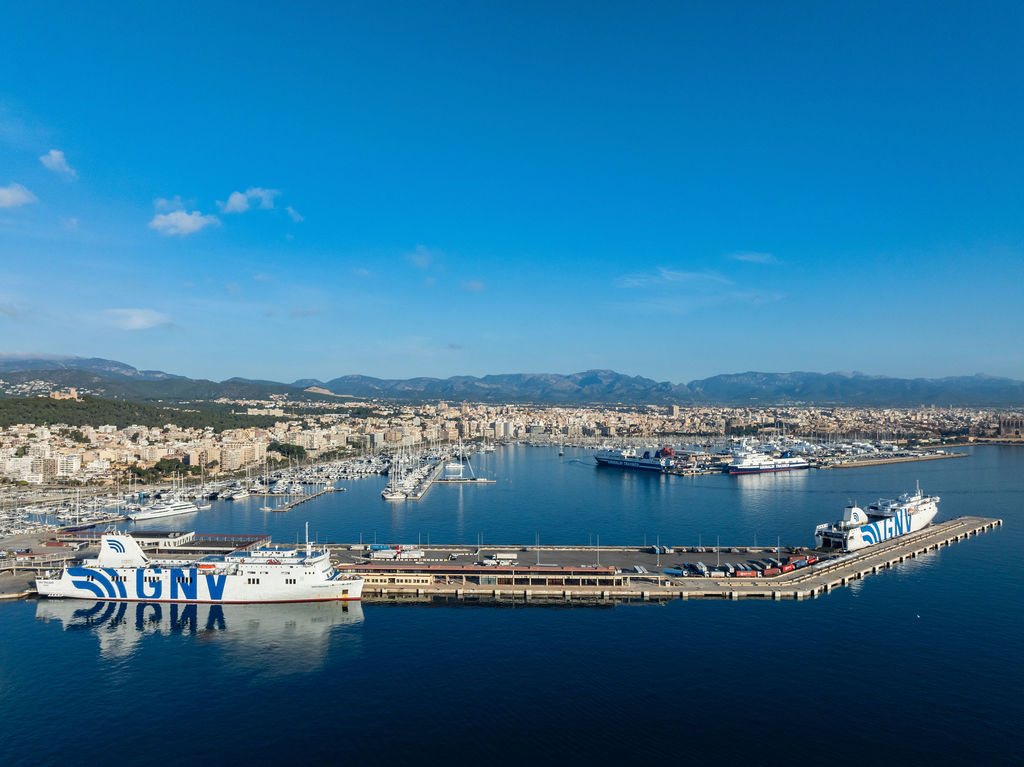
The Balearic Ports Authority (APB) has published the tender specifications for the Master Plan for Port–City Integration of the Port of Palma, an ambitious project that will transform the port’s layout and function, positioning it as a key driver of the island’s economic, social, and environmental development. The transformation, covering an area of 400,000 square metres, is underpinned by a solid, shared, and broadly agreed vision, the result of an intensive dialogue process involving more than 60 economic, social, institutional, and civic stakeholder groups.
The reorganisation of the Port of Palma, which aims to create a new port model seamlessly integrated with the city, promoting sustainability and improving residents’ quality of life, is based on four fundamental strategic pillars. The first, diversification of freight and passenger traffic, seeks to optimise port operations by ensuring proper synchronisation with the logistics chain. Each year, APB manages close to 18 million tonnes of cargo and around 7 million regular line passengers at the Port of Palma—an essential activity for the supply and connectivity of the Balearic Islands. These operations will be concentrated mainly at the Western Breakwater, Poniente Pier, and the Commercial Piers.
The second pillar, focused on consolidating the nautical industry, aims to strengthen the port’s role as a sector benchmark, with the Western Breakwater as the hub of nautical industrial activity. This sector brings together around 800 companies, generates annual revenues of €1.1 billion, and employs nearly 5,000 people, consolidating itself as one of the main economic engines linked to the port.
Cruise activity will be centralised at Poniente Pier. With more than 2 million passengers and around 500 calls annually, the Port of Palma is preparing to offer a smoother and more pleasant experience for both visitors and residents.
Port–city integration is another cornerstone of the project. The Commercial Piers, the Old Pier, and the Counterpier–Mollet will be transformed into spaces accessible to all, promoting public and civic use of the port environment. The area will feature extensive green spaces, recreational areas, and venues for social, cultural, and educational activities. Notably, the relocation of the Dual Vocational Training Centre for Nautical and Fishing Studies will significantly expand capacity and meet training demand, which currently exceeds supply by a factor of five. A second building is also reserved for university degree programmes. The project further includes a new municipal sailing and canoeing school—the first of its kind in Palma—conceived as both a teaching and sports performance centre and integrated with a high-performance facility.
The project also places strong emphasis on innovation and knowledge. At the Commercial Piers and the Old Pier, facilities will be installed such as the headquarters of the Balearic Oceanographic Centre, the new headquarters of SOCIB—already operational—a nautical innovation building known as the Sand Box, and a knowledge transfer centre.
Regarding heritage, the project предусматривает the recovery of the historic Riba Promenade, demolished in 1965, and the stone-by-stone relocation of the Riba Lighthouse to its new location at the end of this avenue, as part of an effort to preserve the port’s historical memory and restore a significant part of the city’s identity.
The entire area will include community-oriented outdoor leisure spaces, extensive green areas, and open zones designed for public enjoyment. The reorganisation of the Port of Palma will be guided by criteria of sustainability, efficient mobility, preservation of the water surface, and connectivity with other urban spaces, moving towards a green port model fully integrated into the city.
The tendering process for the project begins today with the submission of the specifications to the State Procurement Platform and the Official Journal of the European Union (OJEU). Five candidates will be selected to prepare a technical and financial preliminary design, with the final preliminary project expected before the summer of 2026.
The transformation has already begun
The transformation of the Port of Palma is already underway through various actions marking the start of this reorganisation: the remodelling of the seafront promenade, the modernisation of the Club de Mar facilities, the creation of a new industrial area at the Western Breakwater, and the refurbishment of the Balearic Ports Authority’s facilities. Work is also underway on drafting the project for the new Maritime Museum of Mallorca and the reorganisation of Portitxol.
With this project, the Port of Palma will consolidate its position as a model of a sustainable and innovative port, contributing to the development of the city and the island as a whole.
Related links