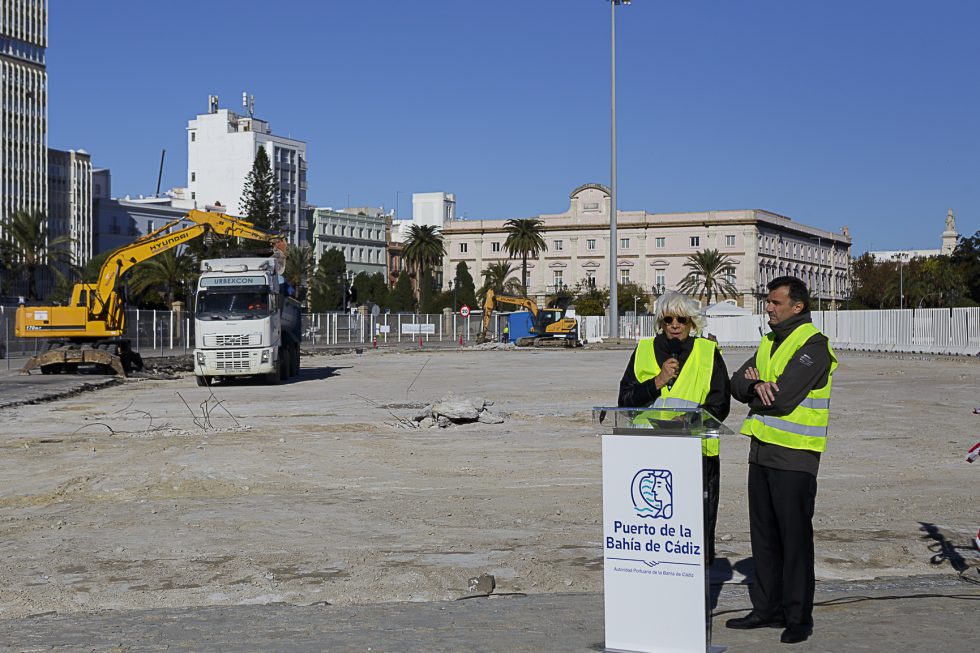
The President of the Port Authority and the Mayor visit the start of the waterfront redevelopment works and highlight their real and symbolic significance
“The redevelopment of Muelle Ciudad is not only a physical transformation of this space; it also symbolizes a new way for citizens to relate to their port.”
With these words, the President of the Cádiz Bay Port Authority, Teófila Martínez, described today—during a site visit accompanied by the Mayor of Cádiz, Bruno García—what the first phase of the waterfront redevelopment project at Muelle Ciudad will mean for both the port and the city, as part of the broader process of integrating this area into the urban fabric.
“We want to open the port to the city, to create new spaces for coexistence as well as economic activity and leisure, and to do so with sustainability, accessibility and respect for the environment and maritime activity,” the President emphasized, recalling that “the Port of the Bay of Cádiz will continue to be a port, and it will also be part of the city.”
The Mayor of Cádiz, Bruno García, noted that “this project represents far more than an urban intervention. It will open the city to the sea, transform a port area into a shared public space, and make economic port activity compatible with a friendly and sustainable citizen use.” He added that, beyond its social value, this integration “will also generate direct and indirect employment and attract new opportunities for the city.”
As explained on site by Eloy Saiz, Head of Infrastructure and Works II at the Cádiz Bay Port Authority, the entire project covers a surface area of 22,500 m², including all the land adjacent to Muelle Ciudad and the junction area with the Junta de Andalucía’s catamaran terminal at the start of Muelle Reina Victoria.
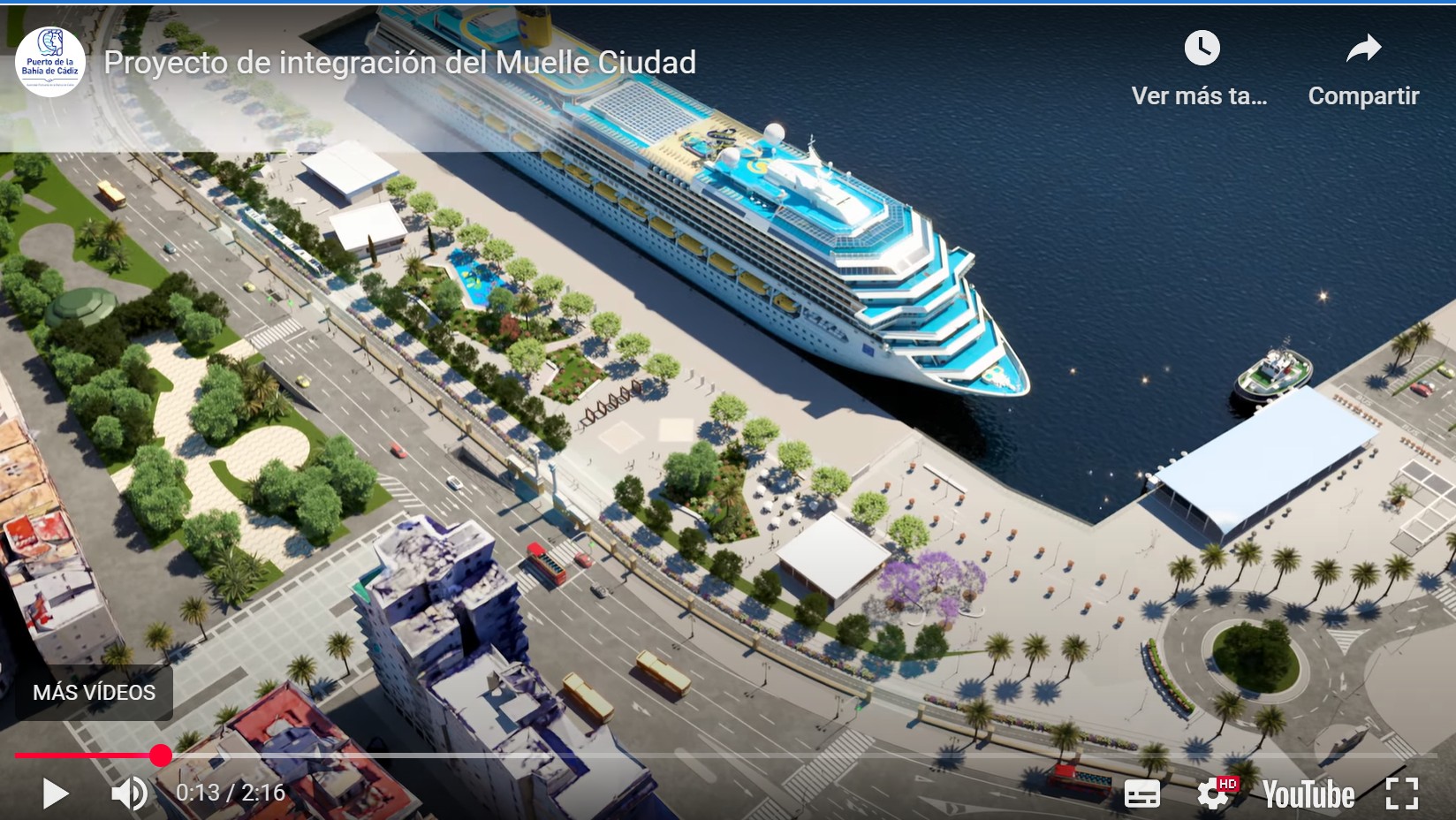
A pedestrian area will be created for public enjoyment with views over the berths of large cruise ships, and a strip will be reserved for the future tram platform, which will run parallel to the existing bike lane. Between these two transport corridors, a landscaped green buffer with trees will serve as an acoustic screen against traffic from Avenida del Puerto.
A 25-metre-wide strip along the quay will be reserved for passenger transit in compliance with the International Ship and Port Facility Security Code (ISPS).
The docking area will remain visible, as the fencing separating it from the public-access area will be glazed. It will also be open during public events when no cruise ships are berthed.
Because the current container terminal has not yet relocated to its new site, the Port of Cádiz must maintain its customs-controlled zone and allow heavy vehicle traffic to continue in the area. For this reason, the redevelopment will be carried out in two phases.
The first phase, which began in early October, will redevelop approximately 14,000 m², corresponding to a 38-metre-wide strip parallel to Muelle Ciudad, featuring large open spaces, promenades, landscaped sections, children’s play areas, walkable fountains, exhibition areas and spaces for restaurant kiosks. It also includes the installation of general service networks for the entire area.
At the beginning of this promenade, next to the new square created at the end of Muelle Ciudad near Plaza de Sevilla, a restaurant module with an outdoor terrace is planned to energize the area, subject to urban planning regulations.
A second hospitality module is planned near the Cruise Passenger Terminal, designed to serve as a reception space for cruise passengers, directly connected to the city’s historic centre.
The landscaped areas will include a wide range of plant species, shrubs and trees. Some will be arranged linearly to separate and protect different zones—such as between the promenade and the future tram platform, or between the tramway and the bike lane. In addition to acting as an acoustic buffer against Avenida del Puerto’s traffic, the landscaping will help absorb the uneven elevation changes between the platforms and the pedestrian walkway.
Vegetation will be distributed along the promenade, with greater concentration in the central green areas, arranged as island-like spaces on both sides of the Puerta del Mar (with a greater presence in front of the Canalejas Gardens). Rest areas with benches will be placed under tree canopies, enabling visitors to enjoy the surroundings and observe, through the glazed barrier, activity at the cruise ship quay.
Between the central green islands and the fencing that marks the Port’s Manoeuvring Area, a discontinuous children’s play area will be installed.
The Puerta del Mar, preserved as a historic landmark, will become the main entrance to the Muelle Ciudad redevelopment. In front of it, a space conceived as an extension of Plaza de San Juan de Dios will feature two walkable fountains and the potential to host open-air exhibitions about the history of the Port of Cádiz.
On the far side of the cruise terminal, near the junction with Muelle Alfonso XIII, an area will be set aside for bus parking to serve cruise passengers. Vehicle access is planned from Avenida del Puerto, although—until the container terminal relocates and Phase 2 is carried out—access will be via the existing inner vehicle lane. When not occupied by buses, this area can function as a multipurpose space suitable for medium-sized public events.
The choice of materials—such as granite cobblestone paving and corten steel—evokes the historical connection with Latin America and the port-related uses traditionally associated with this quay. The landscaping will include species such as Indian Laurel, Orchid Tree, Ombú, Jacaranda, Palm, Dwarf Fan Palm, Lantana, Bougainvillea, and Night-Blooming Jasmine.
The second phase will include the integration of the current roadway—still required for traffic linked to the existing container terminal at Muelle Reina Sofía—as well as the connection of the first phase with Muelle Reina Victoria, incorporating the Junta de Andalucía’s catamaran terminal into the new public space.